Introduction
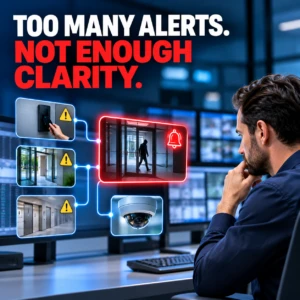
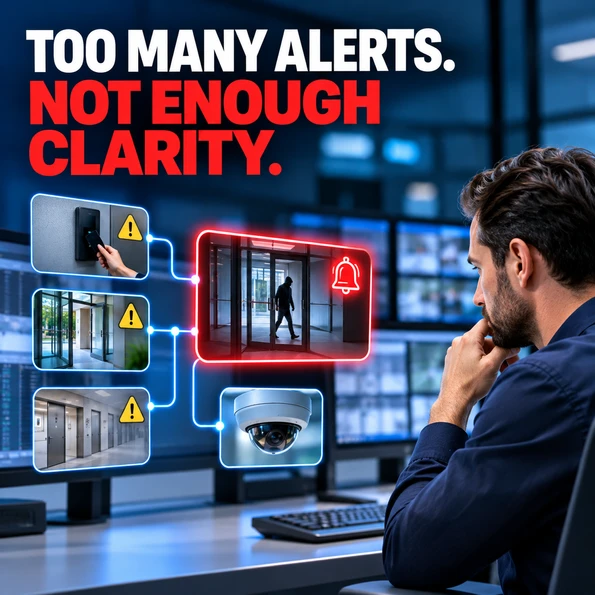
A door-held-open alarm. An access-denied event. Another notification from a different building.
For security operations teams, IT Directors, Facility Managers, and Commercial Property Managers, these events are part of everyday security management. But as organizations expand across more doors, users, and locations, the volume of information can quickly become overwhelming.
The challenge is no longer simply receiving security alerts. It is knowing which alerts deserve attention, which events require investigation, and which notifications are part of normal building activity.
When every security event looks urgent, the events that matter most can become harder to recognize.
That is the alert fatigue problem.
And for organizations managing increasingly complex physical security environments, more notifications do not necessarily mean better protection.
What Is Security Alert Fatigue?
Security alert fatigue occurs when teams receive so many notifications, alarms, and system events that it becomes difficult to consistently identify and respond to meaningful security risks.
In physical access control, not every event indicates a security threat.
An employee presenting an expired credential may generate an access-denied event. A door held open during a delivery may trigger an alarm. A maintenance worker accessing a restricted area outside normal hours may require investigation.
Each event provides information, but not every event requires the same response.
The problem begins when systems present routine activity, operational issues, and potentially serious incidents without enough context to distinguish between them.
Over time, excessive notifications can create unnecessary workloads, slow investigations, and make security teams less effective.
The goal should not be to eliminate security alerts.
It should be to make them more meaningful.
Why Modern Access Control Systems Generate So Much Information
Today’s commercial buildings and enterprise facilities rely on access control systems to manage more than basic entry permissions.
They support employees, tenants, contractors, vendors, visitors, and service providers across different doors, schedules, and locations.
Every interaction can generate a record.
Common access control events include:
Access granted or denied
Doors held open beyond permitted periods
Forced-door alarms
Credentials used outside authorized schedules
Changes to access permissions
Controller or communication issues
Unusual activity requiring further review
Individually, these events can be useful for security monitoring and auditing.
Across hundreds of doors and thousands of users, however, the volume can become difficult to manage.
The challenge becomes even greater when access control, video surveillance, visitor management, and other security systems operate independently.
Security teams may need to switch between multiple platforms to understand what happened, where it happened, and whether action is necessary.
That fragmentation can turn a simple event into a time-consuming investigation.
The Hidden Cost of Too Many Security Alerts
Alert fatigue is not simply an inconvenience. It can affect how effectively an organization manages security.
Slower response to important incidents
When operators must review large numbers of routine notifications, critical events may compete for attention with less significant activity.
A forced-door alarm should not be treated with the same urgency as an employee accidentally presenting an expired credential.
Without clear priorities, response times may suffer.
Increased operational workload
Every unnecessary investigation consumes time.
Facility managers may need to contact employees, security personnel may need to review camera footage, and IT teams may be asked to troubleshoot events that could have been resolved through better system configuration.
For organizations with limited security staffing, these demands can quickly become significant.
Reduced visibility across multiple locations
Managing one building is challenging enough.
Managing a portfolio of commercial properties, corporate offices, or distributed facilities introduces additional complexity.
Different schedules, tenant requirements, access policies, and operating procedures can generate inconsistent notifications across locations.
Without centralized visibility, identifying recurring problems becomes more difficult.
Greater risk of overlooked patterns
An individual access-denied event may be harmless.
Repeated denied attempts at the same restricted entrance, however, may deserve closer attention.
If events are reviewed only as isolated notifications, important patterns can be harder to identify.
Security teams need the ability to understand activity over time, not simply react to individual alarms.
From Security Events to Actionable Intelligence
Modern access control should do more than record what happens at a door.
It should help security teams understand the circumstances surrounding an event.
Consider two situations.
In the first, a door-held-open alarm occurs during a scheduled delivery while authorized personnel are present.
In the second, the same alarm occurs at a restricted entrance after business hours.
The event type may be identical, but the security implications are different.
Understanding that difference requires context.
Useful context may include:
The location of the event
The time and date
The credential or user involved
Applicable access schedules
Recent activity at the same entrance
Related video footage
Previous alarms or recurring patterns
When this information is easier to access and interpret, security personnel can make more informed decisions.
Instead of treating every notification as an isolated problem, teams can evaluate events within the broader operational environment.
That is the difference between collecting security data and using it effectively.
Why Video Integration Matters
Access control systems provide valuable information about credentials, permissions, and door activity.
Video surveillance can provide visual context that helps explain what happened.
When these systems operate separately, security personnel may need to manually locate the relevant camera, identify the correct time, and compare footage with access logs.
That process takes time, particularly when managing multiple facilities.
Integrating access control with video management can simplify investigations by making related information easier to retrieve.
For example, when a forced-door alarm occurs, security personnel may be able to review associated camera footage to determine whether the event involved unauthorized entry, a maintenance issue, or another situation.
The benefit is not simply having more information.
It is having the right information available when it is needed.
For security operations teams, better integration can support faster investigation, more consistent responses, and improved situational awareness.
How AI and Automation Are Changing Security Operations
Artificial intelligence and automation are becoming increasingly important topics in physical security.
Their potential value is not limited to detecting unusual activity.
They can also help organizations manage growing amounts of security information.
Depending on the capabilities of a particular platform, AI-assisted tools may support event classification, pattern analysis, or the identification of activity that warrants further investigation.
Automation can help standardize how certain events are handled, reducing repetitive administrative tasks and improving consistency.
For example, organizations may establish different workflows for routine door conditions, equipment issues, and events requiring immediate security review.
However, automation should not replace sound security policies or human judgment.
A system can help organize information and support decision-making, but security teams remain responsible for determining appropriate responses to critical incidents.
The most effective approach combines technology, clearly defined procedures, and informed human oversight.
Five Ways to Reduce Alert Fatigue Without Reducing Security
Organizations do not necessarily need to replace their entire security infrastructure to improve how they manage alerts.
A more disciplined approach to security monitoring can make a meaningful difference.
1. Review existing alarm configurations
Start by identifying which notifications occur most frequently.
Repeated door-held-open alarms, unnecessary access-denied notifications, or recurring equipment issues may indicate configuration problems or operational conditions that need attention.
Addressing the underlying causes can reduce unnecessary noise.
2. Establish clear event priorities
Not every event requires an immediate response.
Define which conditions represent critical security concerns, which require routine investigation, and which should primarily be recorded for auditing.
Consistent priorities help teams allocate attention more effectively.
3. Connect access events with relevant context
Access logs become more useful when they can be reviewed alongside related information.
Video footage, schedules, user permissions, and location details can help security personnel determine whether an event requires further action.
4. Improve visibility across locations
Organizations managing multiple buildings should establish consistent monitoring and reporting practices.
Centralized access management and consolidated reporting can help teams identify recurring issues and maintain more consistent security operations across properties.
5. Evaluate and improve response procedures
Security operations should evolve as facilities, users, and risks change.
Regularly review alarm frequency, investigation workloads, response procedures, and recurring incidents.
The objective is to reduce unnecessary activity while maintaining appropriate attention to meaningful security risks.
What This Means for Commercial Properties and Enterprise Facilities
For commercial real estate teams, facility managers, and enterprise security departments, alert fatigue is closely connected to operational complexity.
A property manager may oversee multiple tenants with different schedules and access requirements.
A facility manager may coordinate employees, contractors, and after-hours maintenance personnel.
A security director may be responsible for monitoring activity across an entire portfolio.
Each environment generates different security events, but the underlying challenge is similar.
Teams need visibility without being overwhelmed by information.
They need consistent procedures without adding unnecessary administrative work.
And they need access control systems that support investigation and informed decision-making rather than simply producing more notifications.
As organizations expand, these capabilities become increasingly important.
Security operations must scale with the environment they protect, even when staffing and resources remain limited.
The Business Value of Smarter Security Monitoring
Reducing alert fatigue is not only about improving security response.
It can also create operational benefits.
When teams spend less time investigating routine events, they can focus more attention on meaningful security concerns.
When access control and video information are easier to review together, investigations can become more efficient.
When recurring issues are identified and addressed, unnecessary maintenance calls and operational interruptions may be reduced.
And when security teams have clearer visibility across their facilities, they can make more informed decisions about staffing, policies, and infrastructure improvements.
For organizations managing growing portfolios or operating with lean security teams, these improvements can help make security operations more sustainable.
The goal is not to generate fewer records or reduce accountability.
It is to make the information already available more useful.
Final Takeaway
More alerts do not automatically create better security.
As access control environments become more connected and complex, organizations need to move beyond simply collecting events and notifications.
They need a security approach that combines centralized visibility, meaningful context, video integration, consistent policies, and smarter operational workflows.
For IT Directors, Facility Managers, Commercial Property Managers, and Security Operations teams, the priority should be clear: reduce unnecessary noise while improving the ability to recognize and investigate events that matter.
Because effective security is not measured by how many alerts a system generates.
It is measured by how well an organization understands and responds to them.
The future of access control is not more notifications. It is better intelligence.
Millennium is a scalable, hosted, access control platform that services any type of real estate. Our cloud-based solution allows managers and tenants to efficiently manage their physical security from anywhere while enhancing experience and driving profitability.