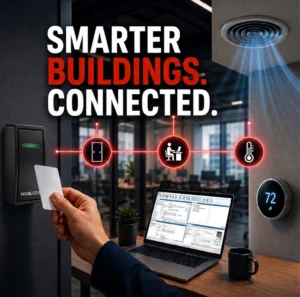
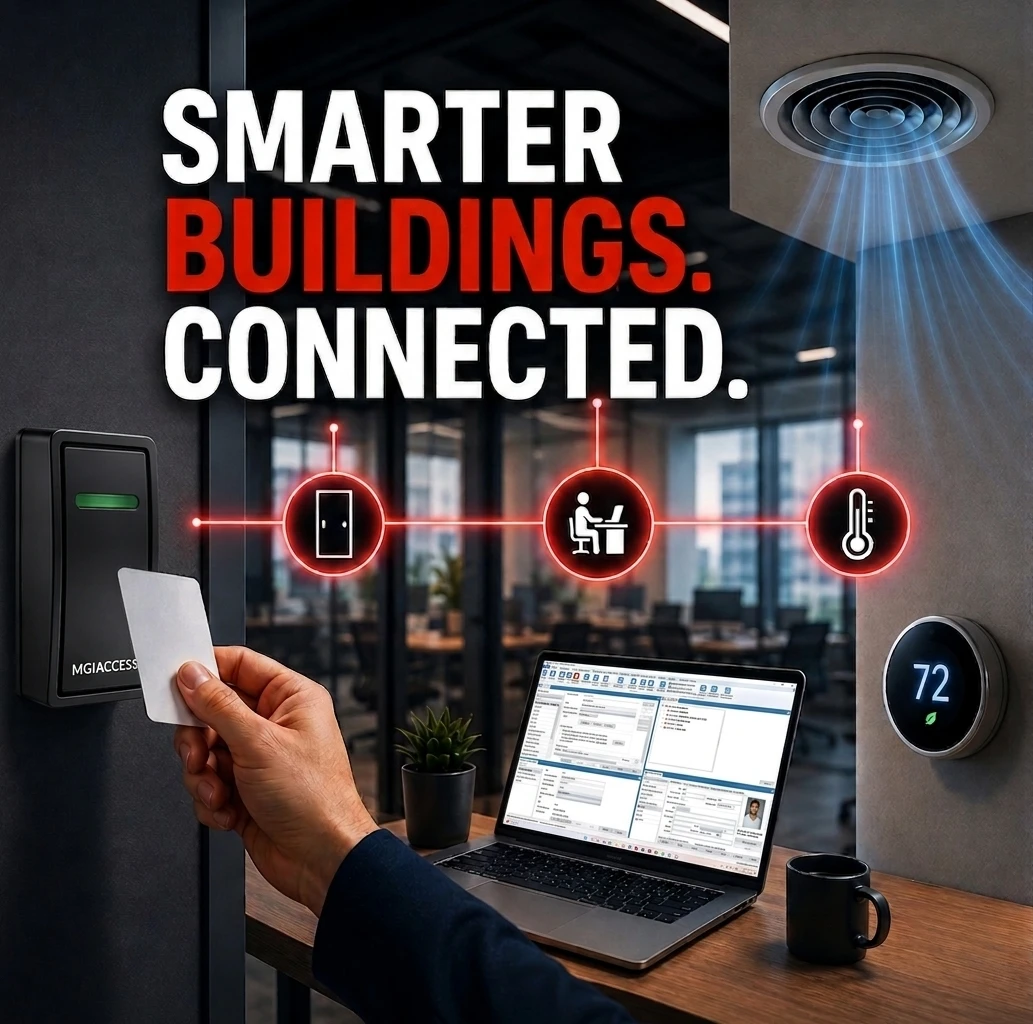
Modern buildings are under pressure from two directions at once: tighter security expectations and more flexible workplace demands. If your doors, HVAC, and desk booking systems still operate in separate silos, you are carrying unnecessary risk, unnecessary friction, and unnecessary operational cost.
That is the core problem, access as infrastructure solves.
Instead of treating physical access as a standalone function, this model connects identity, doors, room and desk reservations, and building operations into one coordinated framework. For IT directors, enterprise facility managers, commercial property owners, CRE property managers, and security operations teams, that shift matters. It improves governance, sharpens visibility, and helps the building respond to real-world use instead of static assumptions.
Why access as infrastructure matters now
The modern workplace is no longer fixed. Hybrid schedules, shared spaces, rotating tenants, contractors, and visitors have made static access models harder to defend and harder to manage. At the same time, enterprises are expected to operate under a Zero Trust mindset, where access is granted based on identity, policy, and context rather than broad trust.
That is where access as infrastructure becomes valuable.
It creates a foundation where:
- door access follows identity and policy
- desk booking reflects actual workspace intent
- HVAC responds more intelligently to occupancy and usage
- security teams gain better auditability
- facilities teams gain better operational control
- IT can reduce fragmentation across systems
The goal is not to force every system into one platform. The goal is to make them work together securely.
The problem with disconnected systems
When access, facilities, and workplace tools do not talk to each other, each team ends up managing a partial version of the truth.
Security may know who opened a door.
Facilities may know which zones are being conditioned.
Workplace teams may know who reserved a desk.
But if those signals are never connected, your organization loses the context needed to enforce policy, reduce waste, and respond quickly to exceptions.
That creates predictable problems:
- users keep access longer than they should
- manual exceptions pile up
- desk reservations do not align with physical access
- HVAC runs without clear occupancy context
- audit trails are harder to interpret
- IT and facilities remain trapped in separate operational models
In enterprise environments, those gaps are not just inefficient. They are risk multipliers.
Doors are the enforcement point
Doors are where policy becomes real.
A user may exist in an identity system, a reservation platform, and a facilities database, but the access decision ultimately happens at the door. That is why modern access control needs to be secure, auditable, and interoperable.
A strong access architecture should support:
- role-based access control
- schedule-based permissions
- audit logs for access events
- mobile or credential-based entry
- directory integration
- lockdown and emergency response workflows
- scalable administration across many doors and sites
Where possible, organizations should prefer established industry standards and well-documented protocols rather than closed, isolated implementations. For example, the Security Industry Association’s Open Supervised Device Protocol, or OSDP, is widely used in access control environments to improve secure communication between readers and controllers. That kind of interoperability matters when you are modernizing legacy infrastructure.
HVAC should not be blind to occupancy
HVAC is one of the largest operational systems in a building, and it should not be managed in isolation from how the space is actually used.
When HVAC is disconnected from access and booking systems, buildings often heat, cool, and ventilate space without enough context. A reserved desk does not always mean the space is occupied. A badge event does not always mean a person is staying for the day. But when workplace data, occupancy signals, and access policy are considered together, facility teams can make more informed decisions.
That does not mean access control should directly drive mechanical systems in a simplistic way. It means HVAC strategy should be informed by occupancy-aware data where appropriate, with clear governance and risk controls. In enterprise environments, deliberate integration is better than brittle automation.
Doors are the enforcement point
Doors are where policy becomes real.
A user may exist in an identity system, a reservation platform, and a facilities database, but the access decision ultimately happens at the door. That is why modern access control needs to be secure, auditable, and interoperable.
A strong access architecture should support:
- role-based access control
- schedule-based permissions
- audit logs for access events
- mobile or credential-based entry
- directory integration
- lockdown and emergency response workflows
- scalable administration across many doors and sites
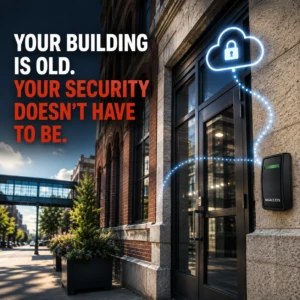
Modern access control environments increasingly rely on secure communication protocols and open standards to improve interoperability between readers and controllers. The Security Industry Association’s Open Supervised Device Protocol (OSDP) is one example adopted across the industry when modernizing legacy infrastructure. Choosing well-documented standards and interoperable technologies can help organizations reduce complexity and better prepare for future system integration.
What enterprise buyers should expect from a connected architecture
Different stakeholders care about different outcomes, but they all want the same thing: less fragmentation and more control.
IT Directors
IT needs fewer disconnected tools, cleaner identity integration, and systems that can be managed without creating shadow workflows. Access platforms should fit into enterprise identity governance and support secure administration at scale.
Enterprise Facility Managers
Facilities need occupancy-aware operations, less manual intervention, and better alignment between space usage and building systems. When access and booking systems are coordinated, facility planning becomes more accurate.
Commercial Property Owners and CRE Property Managers
Property leaders need flexibility across tenants, suites, and common areas. They also need scalable operations that support changing occupancy without sacrificing security or visibility.
Enterprise Security Operations Teams
Security needs clear audit trails, enforceable policy, and tools that support incident response. Access systems should help security teams see what happened, when it happened, and who was involved.
The architecture principles that matter
A modern access-as-infrastructure model should be built on a few practical principles.
1. Identity first
Access should follow the user’s identity lifecycle. Onboarding, transfers, and offboarding should drive permissions, not manual lag.
2. Least privilege
Users should only have access to the spaces, times, and functions they need.
3. Interoperability
The system should work with identity platforms, building systems, and workplace tools through documented integrations and standards.
4. Auditability
Access events, changes, and exceptions should be traceable.
5. Deliberate integration
Not every workflow needs real-time automation. Some should be event-based. Some should be schedule-based. The right design depends on operational risk, not convenience alone.
6. Cloud-native manageability
Modern organizations need visibility and control without relying entirely on legacy on-prem complexity. Cloud-managed access control can help reduce administrative friction while improving scalability and reporting.
Common gaps in the market
One of the biggest gaps in this category is that many solutions do one part well and stop there.
Some are strong at doors but weak on workplace orchestration.
Some can handle scheduling but lack serious security depth.
Some can manage facilities data but do not integrate cleanly with identity governance or physical enforcement.
The real opportunity is in bridging those layers:
- access control
- workplace booking
- occupancy-aware operations
- identity management
- cloud administration
- reporting and audit visibility
That is the difference between a point solution and a workplace infrastructure strategy.
How to evaluate a solution
If you are reviewing vendors or modernizing your stack, ask whether the platform supports:
- secure credentialing
- mobile access options
- directory integration
- role- and schedule-based policies
- centralized reporting
- lockdown workflows
- scalable management across sites
- documented integration paths
- support for legacy modernization without a full rip-and-replace
You should also ask whether the platform helps connect physical access to the broader workplace ecosystem, rather than isolating it from HVAC, reservations, and occupancy data.
Where Millennium fits
Millennium Ultra is built for facilities of all sizes, from a single door to thousands across multiple campuses. It is designed to support modern access control needs while giving organizations a path toward more connected operations.
For enterprises that want to reduce silos between security, facilities, and workplace systems, Millennium provides a modern platform for managing access as part of the broader building infrastructure. That means stronger control at the door, better visibility across operations, and a more scalable foundation for future integrations.
Conclusion
Access as infrastructure is not a trend. It is the practical response to how buildings actually operate now.
If you still manage doors, HVAC, and desk bookings as separate problems, you are asking your teams to work harder than they should and leaving context on the table. A connected model gives you better security, better governance, and better operational alignment.
For IT, that means fewer silos.
For facilities, that means more intelligent building operations.
For security, that means better enforcement and auditability.
For property teams, that means a more adaptable workplace.
And for the organization as a whole, that means access becomes what it should have been all along: infrastructure.
Millennium is a scalable, hosted, access control platform that services any type of real estate. Our cloud-based solution allows managers and tenants to efficiently manage their physical security from anywhere while enhancing experience and driving profitability.