By now, your IT department has likely implemented Zero Trust architecture across your corporate network. You authenticate every user, encrypt data in transit, and segment your environments to prevent lateral movement.
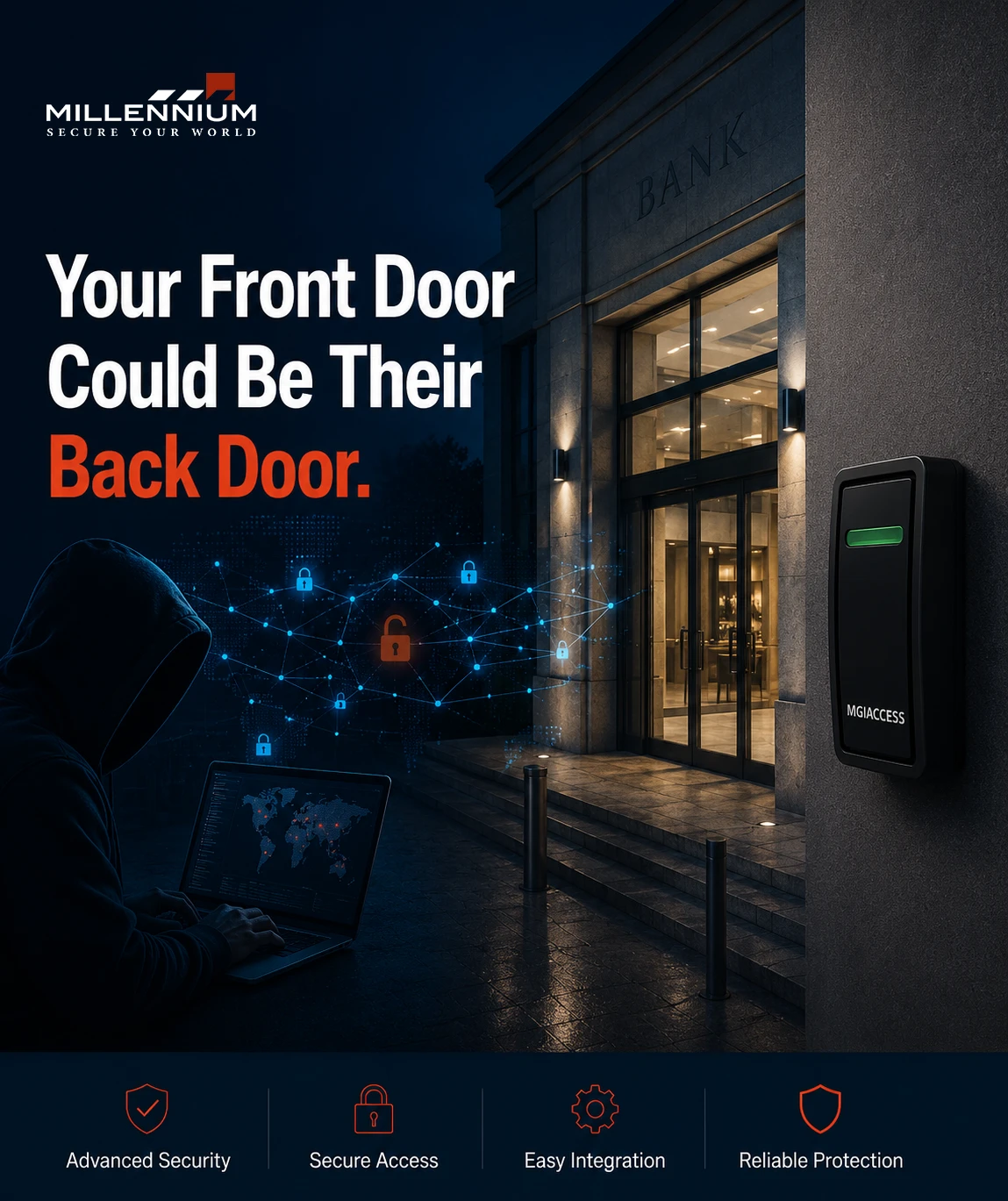
But what happens when the weakest link in your network isn’t a phishing email or an unpatched server, but the card reader hanging on your lobby door?
According to recent 2026 threat intelligence, physical security hardware has become a primary lateral movement vector for threat actors targeting enterprise networks. We are witnessing a critical convergence: hackers are bypassing firewalls by targeting the building itself.
Welcome to the cyber-physical gap. Here is why your legacy access control system is an unmanaged attack surface—and how to lock it down.
The Wiegand Vulnerability: An Open Door on Your LAN
For decades, the physical security industry relied on the Wiegand protocol to transmit data between door readers and access controllers.
From a cybersecurity perspective, Wiegand is a nightmare. It transmits data in plain text, meaning there is zero encryption between the reader on the outside of your building and the controller inside. Threat actors equipped with a $30 BLE skimmer or a pocket-sized implant can splice into the low-voltage wiring, sniff the plain-text badge data, and clone credentials perfectly.
But the threat extends far beyond unauthorized physical entry.
Legacy access controllers are essentially bare-bones Linux boxes. They sit on your corporate network, often running outdated, unpatched firmware because they are managed by the Facilities team rather than IT. Once an attacker compromises a reader and gains access to the local controller, they have an established foothold on your LAN. From there, it is a textbook lateral pivot to the data center.
The Silo Problem: When Facilities and IT Don’t Talk
The cyber-physical gap thrives in the organizational void between Facilities and IT.
When physical security operates in a silo, access controllers are rarely subjected to routine IT vulnerability scans or penetration tests. They are treated as “building infrastructure” rather than “IoT network endpoints.”
This creates severe architectural flaws:
- Unsegmented Networks: Controllers are frequently placed on the primary corporate VLAN rather than a strictly segregated IoT network.
- On-Premise Server Liabilities: Legacy access control relies on local servers sitting in a utility closet. These servers run outdated Windows environments, lack endpoint detection and response (EDR) software, and act as a lucrative target for ransomware.
- Stale Credentials: Without automated syncs to Active Directory or Okta, terminated employees retain physical access long after their digital access is revoked.
Applying Zero Trust to the Physical Layer
To close the cyber-physical gap, organizations must apply the core tenets of Zero Trust—never trust, always verify, assume breach—to their physical doors. Here is what the Zero Trust Facility looks like in practice: End-to-End Encryption: Organizations should move away from legacy communication methods and adopt modern, secure technologies that help protect data transmitted between credentials, readers, and controllers. Secure communications help reduce the risk of interception, spoofing, and unauthorized access. Identity-Driven Provisioning: Access control must become a node on your IAM (Identity and Access Management) tree. When an employee is offboarded in your identity management system, their physical access should be revoked promptly across the organization. Cloud-Native Architecture: The most effective way to reduce the risk associated with local access servers is to minimize dependence on them. Transitioning to a cloud-hosted Access Control as a Service (ACaaS) model shifts management and computing resources off-premise and into a professionally managed cloud environment.Closing the Gap with Millennium Ultra
At Millennium Group, Inc., we engineered the Millennium Ultra platform specifically to bridge the divide between IT and physical security. By removing the vulnerable on-premise server and moving the control plane to a secure, cloud-hosted environment, Millennium Ultra eliminates the primary target for ransomware in the physical security stack. Firmware updates are pushed automatically, ensuring your controllers are never running stale, exploitable code. Combined with seamless Active Directory integrations and fully encrypted reader communications, Millennium Ultra transforms your access control from a network liability into a hardened perimeter defense. IT security shouldn’t stop at the lobby doors. It’s time to bring your physical infrastructure into your Zero Trust architecture. Are your access controllers acting as a backdoor to your IT network? Book a demo of Millennium Ultra today to see how cloud-native access control secures your physical and digital perimeters simultaneously.Millennium is a scalable, hosted, access control platform that services any type of real estate. Our cloud-based solution allows managers and tenants to efficiently manage their physical security from anywhere while enhancing experience and driving profitability.