
Audit-Ready Access: Automating Compliance and Governance for 2027
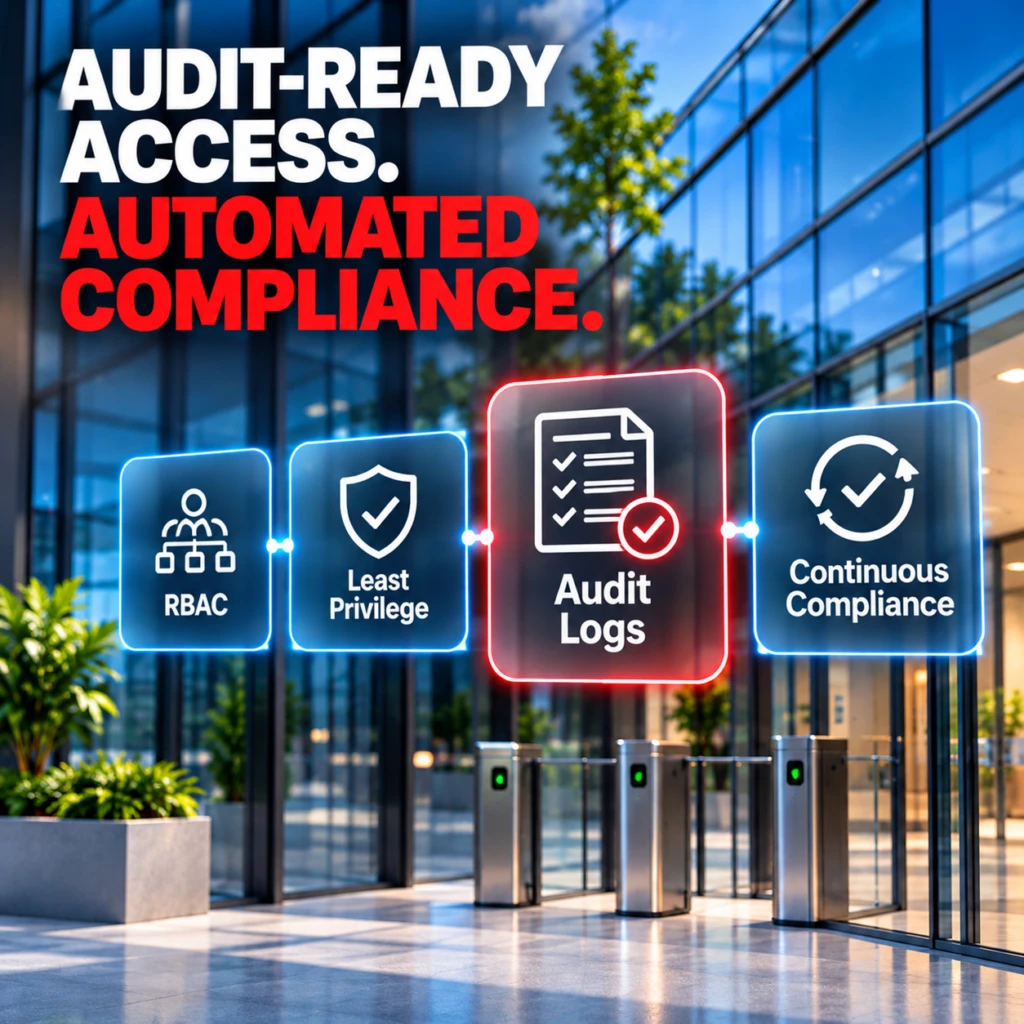
Enterprise access environments are getting more complex, not less. IT teams, security operations, facility leaders, and property managers are expected to control who can enter buildings, systems, and sensitive spaces while also proving that those controls are consistently enforced. In that environment, audit-ready access is no longer a best practice — it is an operational requirement. By 2027, organizations will need more than periodic reviews and spreadsheet-based access lists. They will need access governance automation that supports continuous compliance, produces reliable audit evidence, and reduces the manual burden on IT, security, and facilities teams. The core principles remain familiar: least privilege, role-based access control (RBAC), audit log management, and strong governance processes. What changes is the expectation that these controls should be embedded into daily operations, not added after the fact. (csrc.nist.gov) Why Audit-Ready Access Matters Now Audit readiness has traditionally been treated as a point-in-time event. Teams prepare evidence when a review, certification, or assessment is approaching, then move back to business as usual. That model creates risk because access permissions, contractor relationships, tenant needs, and staff responsibilities change constantly. Modern compliance frameworks emphasize ongoing control over access and logging. NIST guidance supports access control based on policy, role, and least privilege, while CIS Controls v8.1 specifically calls for access control management and audit log management as core safeguards. ISO/IEC 27001 and ISO/IEC 27002 also frame access control as part of a broader information security management system. (tsapps.nist.gov) For enterprise facilities and commercial real estate environments, that means the same governance discipline should apply across: employee badge access contractor and vendor access tenant-specific permissions privileged administrative access physical and logical access review processes When these controls are fragmented, audit preparation becomes expensive and error-prone. When they are automated, organizations can improve oversight while reducing manual work. What “Audit-Ready Access” Means in Practice Audit-ready access is the ability to prove, at any moment, that access is: approved appropriate to the user’s role time-bound where needed logged reviewed revoked when no longer required This is where identity governance and access governance automation become critical. A mature access program should not simply issue credentials. It should maintain an ongoing record of why access exists, who approved it, when it was last reviewed, and whether it still aligns with policy. In practical terms, audit-ready access usually includes: Defined roles and entitlementsAccess is mapped to job function, location, tenant, or operational need. Least privilege enforcementUsers receive only the minimum access necessary to perform assigned tasks. NIST defines least privilege as restricting privileges to the minimum necessary to accomplish assigned tasks. (csrc.nist.gov) Reviewable access decisionsEvery approval, change, and revocation can be traced. Audit logs and retentionEvents can be reviewed to detect, understand, or recover from attacks or policy violations. CIS explicitly identifies audit log management as a core control. (cisecurity.org) Governance workflowsAccess changes follow standardized approvals, exceptions, and recertifications. The 2027 Shift: From Periodic Reviews to Continuous Compliance The biggest shift heading into 2027 is the move from reactive compliance to continuous compliance. This does not mean replacing human oversight. It means automating the repetitive parts of governance so people can focus on exceptions, investigations, and policy decisions. Continuous compliance is especially important in environments where access changes quickly: seasonal staffing contractor rotation tenant turnover new facilities or sites hybrid work and remote administration temporary emergency access Automation helps by standardizing the workflow around access requests, approvals, renewals, and revocations. It also helps teams detect drift — for example, when a user’s access no longer matches their role or when an inactive credential remains enabled. Industry guidance supports this approach. CIS Control 6 focuses on managing access privileges, and CIS Control 8 focuses on collecting, alerting, reviewing, and retaining audit logs. NIST also emphasizes role-based and policy-driven access control. (cas.docs.cisecurity.org) The Business Case for Access Governance Automation For IT directors and enterprise security leaders, the value of automation is not just compliance. It is operational clarity. 1. Faster audit preparation When access data, approvals, and logs are centralized, teams can produce evidence faster and with less manual reconciliation. 2. Lower risk of stale access Automated recertification and expiration policies reduce the chance that old accounts or overprivileged users remain active. 3. Better accountability RBAC and approval workflows make it easier to determine who approved what, when, and under which policy. 4. More consistent enforcement Policies applied through workflows are less likely to vary by site, manager, or department. 5. Improved collaboration across teams Facilities, security, IT, and property management can work from the same governance model instead of maintaining separate spreadsheets or siloed approval paths. Key Components of an Audit-Ready Access Program 1. Role-Based Access Control RBAC assigns access based on role rather than individual preference. NIST describes RBAC as a way to manage access based on job function, and it has long been recognized as a practical model for enterprise security. (csrc.nist.gov) In commercial environments, RBAC can be used to separate: corporate administrators building operators tenant users contractors security personnel temporary visitors 2. Least Privilege Access Least privilege is foundational. If a user only needs access to a subset of doors, applications, or administrative functions, they should not have broader privileges by default. NIST and CIS both support this principle as a core access control safeguard. (csrc.nist.gov) 3. Strong Audit Logging Logs should capture access events, privilege changes, approvals, denials, and administrative actions. CIS Control 8 is explicit that audit logs should be collected, reviewed, and retained to help detect, understand, or recover from an attack. (cisecurity.org) 4. Access Review Workflows A strong governance program requires regular access reviews. These reviews should verify: whether access is still needed whether the role has changed whether the user is still active whether any exceptions exist whether high-risk access requires additional approval 5. Separation of Duties For sensitive environments, no single person should control every step of the process. NIST 800-171 discusses separation of duties, including ensuring personnel who administer access control functions do not also administer audit functions. (nvlpubs.nist.gov) How Automation Supports Compliance and Governance